
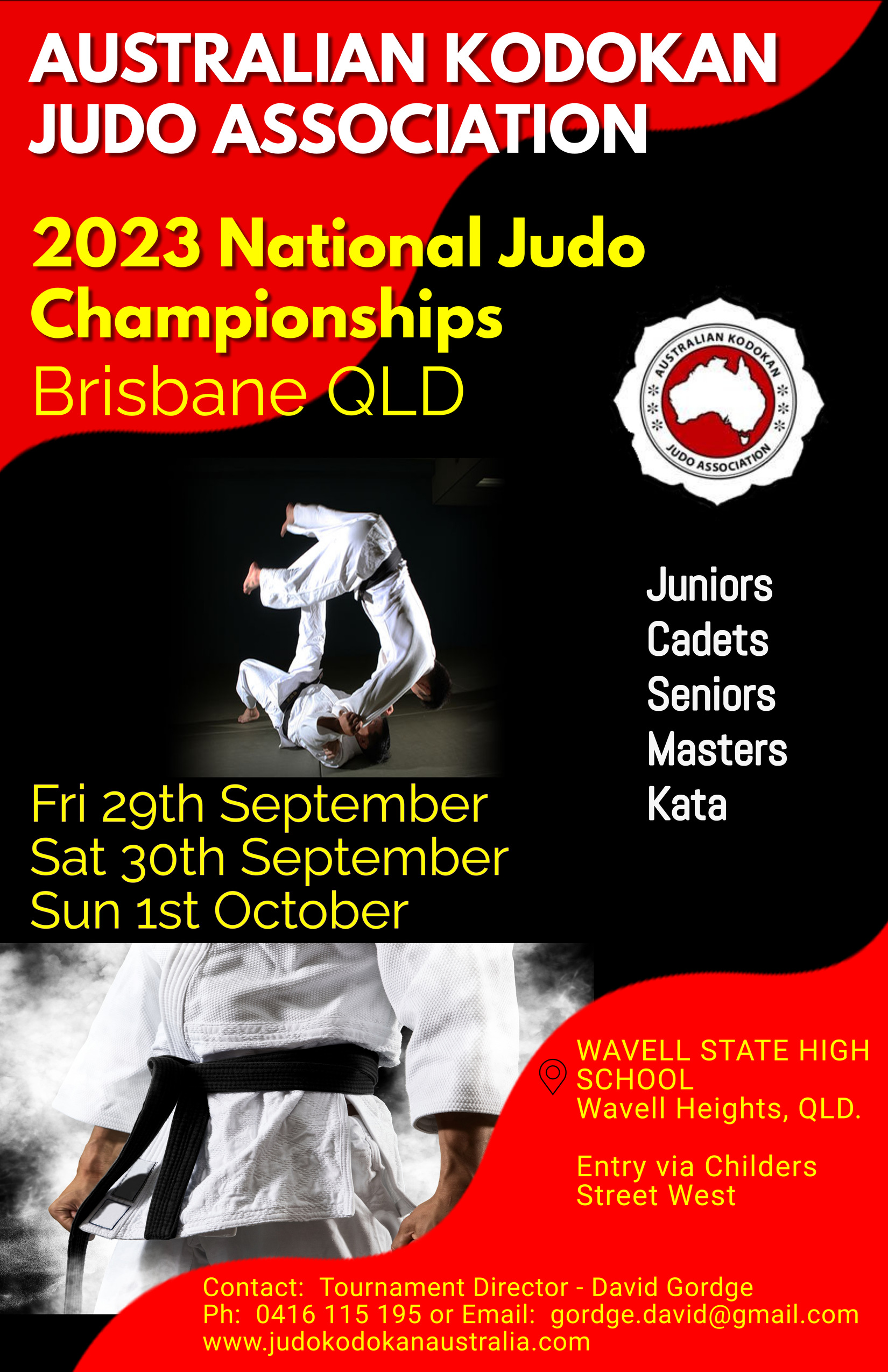
2013 Championships

The 2013 AKJA Australian Kodokan Judo Championships will be held at La Trobe University, Bundoora, Melbourne.  Running from the 12th-14th July, the championships include a Kata Tournament and Shiai for Juniors, Intermediates, Seniors and Veterans divisions.
The International Martial Arts Games will be held in Melbourne May 10-11 2013.  The AKJA will be running the Judo event on the 11th on behalf of the WJF.  Further details and entry forms available here

Australian Kodokan Judo Championships that will be held at the La Trobe University, Bundoora Campus, Melbourne on 12-14th July 2013.

COMPETITION OVERVIEW:

  • Shiai: Junior, Intermediates, Seniors and Veterans.
  • Kata

IMPORTANT INFORMATION:

poster


The International Martial Arts Games will be held in Melbourne May 10-11, 2013.  The Australian Kodokan Judo Association will be running the Judo event on the 11th on behalf of the World Judo Federation.

5th International Martial Arts Games 2013
Melbourne – Australia
Open Judo Tournament
Saturday 11th May 2013
State Netball & Hockey Centre

Divisions
Juniors: 10-12yrs, 13-15yrs
Intermediates: 16-17yrs
Seniors: 18 and over
Masters: (Where entries permit)

IMPORTANT INFORMATION:

Registrations can be made by contacting the Tournament Director (David Gordge) via email. More information also available at the International Martial Arts Games Committee website.

Poster


It is with deep sadness that we have to inform you all of the passing of Sensei Keiko Fukuda, 10th Dan on the 9th of January.  She gave her life to Judo and contributed much.  We should remember her teachings and do our best in life to follow them.


In August 2012, two players from Goshin Judo Kan at Clarence Gardens travelled to Brasilia, Brazil in South America to compete in the World Judo Federation Junior World Championships. Eighteen year old Rhys Gordge and Sixteen year old Hugh Callow competed against players from other countries with both winning Bronze Medals in their respective divisions. The AKJA part sponsored both with funding to assist with travel to the event.

Rhys, who in 2010 previously represented Australia in Osaka, Japan returned in November 2012 to compete in the Osaka International Goodwill Judo Tournament where players from 28 countries participated. Rhys competed in the U20yr division which was an Open Weight category. Rhys fought well to get into the finals only losing to one competitor who went on to win the Gold Medal. Rhys won a Bronze Medal having been placed 3rd in the tournament.

Coach of the two boys and AKJA National President, Mr David Gordge says “Both boys represented Australia well which reflects the technical abilities of the Kodokan Judo Association in a world class environment.”

Rhys Gordge 3rd Place medal presentation

Rhys Gordge 3rd Place medal presentation

Hugh Callow 3rd Place medal presentation

Hugh Callow 3rd Place medal presentation

David Gordge with Rhys & Hugh after WJF Competition

David Gordge with Rhys & Hugh after WJF Competition

WJF President Mr Jaime Casanova with Rhys & Hugh

WJF President Mr Jaime Casanova with Rhys & Hugh


The results for the 2012 National Championships are now available to download here.


Taiichi Ohno

Taiichi Ohno - Lean Thinker

The Benefits of Do – The other half of Ju

Taiichi Ohno image © Toyota Corporation

This principle of judo offers a basic principle that can provide a sound answer for every situation and every question. The easiest way to master the this basic principle is to practice the waza of judo and to embark on the do. That is because, through practice that incorporates both a martial art and physical education, one can learn a method for making the most effective use of one’s mental and physical energy. Then one learns to apply this to every aspect of human affairs. I believe that this basic principle is the most appropriate method for resolving various moral issues. – Sensei Jigoro Kano (Mind Over Muscle, p. 83)

In the book, Mind over Muscle, Jigoro Kano discusses in depth what he held in his mind when he conceived of Judo and its purpose. Chief amongst these purposes was the thought that Judo should be more than just a martial art, more than just a sport, and more than just something one does for a few hours a day, on every other day. He conceived that we should make moral decisions and choices that were effective, decisive and added value to the world. For the purpose of this article, let me define moral to mean the understanding we have about right and wrong behaviour. Some might call it attitude.

Kano developed Judo in a time in which Japan had been undergoing a reemergence into the world-at-large, and the Meiji Restoration in (明治維新 1868), saw the Meiji era (明治時代 1868 –1912) begin. Japan was opening its doors to trade, commerce and an exchange of ideas, particularly those from the West, and Europe in particular. These 40 odd years saw Japan emerge as a world power, and many of the systems we use today in manufacturing, such as Lean Thinking, owe their origins to the changes that were implemented. It is true that Henry Ford began this type of production, but it was the Japanese who took it to the logical next level, and the Toyota Production System (TPS) and the Toyota Way, is arguably the pinnacle of this methodology. Maximum Efficiency or Seiryoku Zenyo.

So, I want to go even one step further and suggest that Kano’s philosophy of Judo, and its Principles, particularly Seiryoku Zenyo actually epitomises this way of thinking, that the mutual concern and assistance for each other allows us, is in fact the key, to maximising our time and energies. That is judo in a nutshell, and while it might be going a bridge too far to suggest that Kano was responsible for Toyota’s TPS, it is certainly clear that Taiichi Ohno (大野 耐 February 29, 1912 – May 28, 1990) would have been exposed to the National Physical Education System that was being practiced in Japan at that time. It’s ethos would have been firmly imprinted in every person undertaking formal education in Japan.

The evidence is there if we look at the above example of the Toyota Way, in that it too espouses closely similar approaches to what Kano had in his mind when he developed judo. If we compare what Sensei Shinichi Oimatsu says about Kano’s intentions for all humanity, that through Judo we can come to realise that we are “people of value” and have much to add to our society by being so, and further, that we can act in a way that produces “mutual benefit (jita kyoei)” for all, then I do not think it is a far cry to see that the Toyota Way has had much influence from the philosophy of Judo. (source: The Bulletin for the Scientific Study of Kodokan Judo, Volume VI, 1984 cited at www.judoinfo.com – a thoroughly excellent article.)

Now, let us say I have drawn a long bow here, and that the similarities are just coincidental; at the very least we can say that I have shown that the world has benefitted from an attitude of Seiryoku Zenyo and Jita Kyoei. Where would manufacturing be today without it? This brings me to the quote at the top of this article. Much of modern judo has forgotten that judo was meant to be more than what it has become. We see argument after argument that modern judo epitomises the whole Seiryoku Zenyo and Jita Kyoei that Kano devised. I just don’t see it. What I do see is judoka who play to win at all costs, who look down at their just–defeated opponent and look at them with disdain, or run around the mat pumping their fists in the air, or even, as happened to me a few years ago, my opponent belched in my face after having just beaten me. There is no respect of others in these acts; they are selfish acts, and not morally sensitive.

That isn’t judo; it certainly isn’t the kind of thing Kano had in mind when he coined those dual phrases for judo. I see duplication of resources, or bottlenecks in systems that prevent funding from reaching all, particularly grass–roots level players, and the waste of time spent on pursuing strength judo is astounding. Yes, let’s become strong in body, mind and spirit, but let’s do so by commitment to the waza, to randori, to kata, to shiai and to each other. Think on the title of the book I’m quoting from; it’s called that for a specific reason.

In Mind over Muscle, Sensei Kano points out that:

When people are by themselves, the principles of seiryoku zenyo can be applied without any trouble, but when there is a group of two or more people, it simply takes one person to act selfishly, and conflict can easily arise. But if every party in a group avoids acting selfishly and acts according to the needs and circumstances of other people in the group, then conflict can naturally be avoided and harmony achieved. Conflict is to mutual detriment as harmony is to mutual gain. (ibid. p. 70)

It is disingenuous to play judo, then run around screaming “Victory is mine!” after a succesful bout, as this kind of moral conduct does nothing to promote judo or assist your fallen brother/sister in judo, and all to promote selfishness, winning and the me first attitude. Sure, celebrate, but leave the show–stopping stuff for the privacy of the change room. The do of judo is, as Kano points out, the way, and the way is learned by mutual participation and agreement through waza, that allows you to train in harmony with those in your club, to compete in harmony with those from other clubs, and to apply the lessons that judo writes on our bodies, minds and spirits in our everyday lives. True Judo happens when it is the way you live, not just what you do. Seiryoku Zenyo and Jita Kyoei are a way of life, and not just a fashion accessory.


The Australian Kodokan Judo Association inc. will be posting news and events in this section. Please feel free to click on the RSS icon to the right to automatically receive notification of updates to this site. RSS Feed Icon